PRP Platelet Rich Plasma Therapy
PRP (Platelet Rich Plasma) therapy is a cutting-edge regenerative treatment that concentrates your own blood's healing platelets and injects them directly into damaged tissue. By delivering a high-dose payload of growth factors — including PDGF, VEGF, and TGF-β — PRP activates the body's natural repair mechanisms to rebuild tendons, ligaments, cartilage, and joints. It is a non-surgical, outpatient procedure that addresses the biological root cause of chronic musculoskeletal pain rather than simply masking symptoms.
- Activates the body's own biology to accelerate natural healing
- Reduces chronic joint, tendon, and soft tissue pain without surgery
- Avoids the tissue-degrading effects of repeated corticosteroid injections
- Stimulates collagen synthesis and cartilage matrix production
- No risk of allergic reaction — derived entirely from the patient's own blood
- Minimal downtime — most patients resume normal activities within days
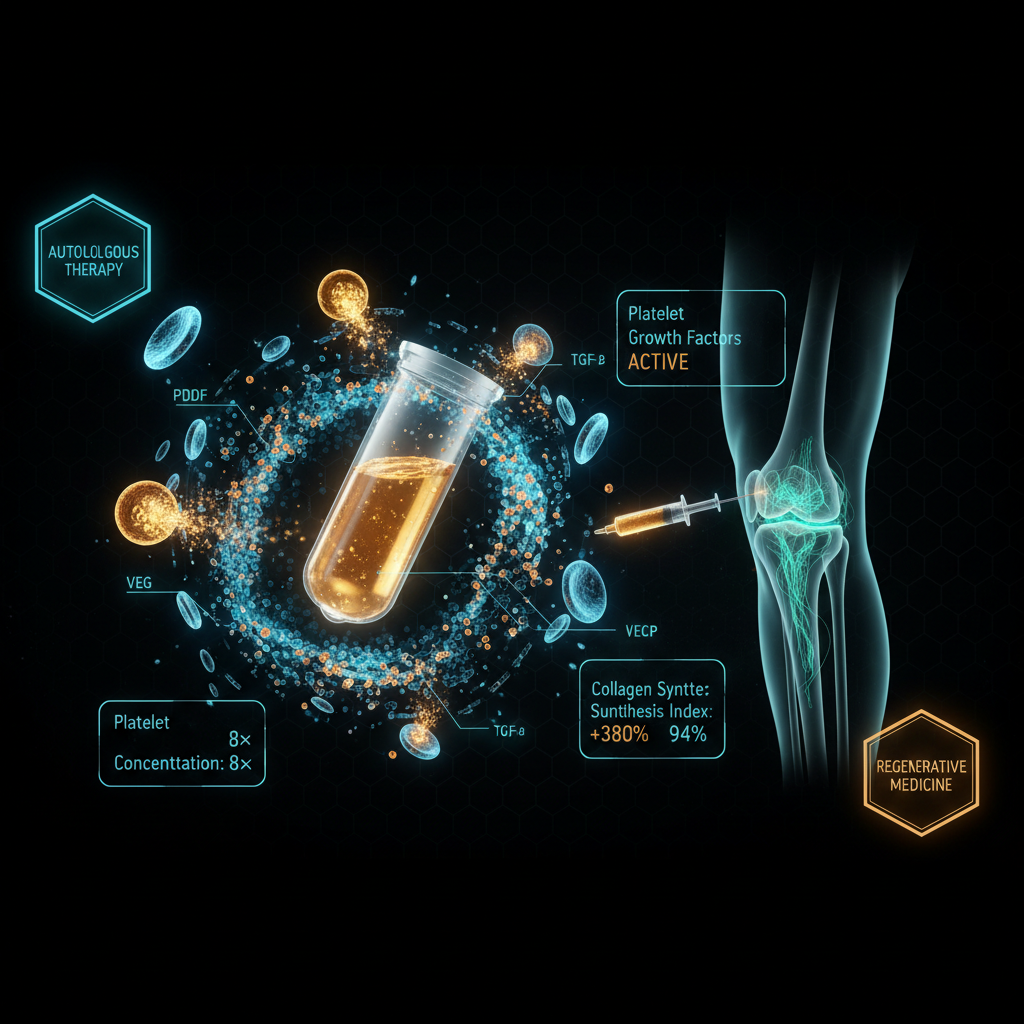
PRP (Platelet Rich Plasma) therapy is a regenerative injection treatment in which a physician draws a small sample of the patient's blood, processes it in a centrifuge to concentrate the platelet fraction 5–10× above baseline, and injects the resulting PRP directly into the injured tissue. Platelets release growth factors that signal the body to repair damaged cells, synthesize new collagen, and restore tissue integrity. PRP is used to treat chronic musculoskeletal pain caused by tendon degeneration, ligament injury, cartilage damage, and joint arthritis — conditions that often fail to resolve with rest, physical therapy, or steroid injections alone.
How PRP Therapy Works
A precision-guided regenerative protocol that harnesses your body's own biology to repair damaged tissue, restore function, and deliver lasting pain relief.
Concentrated Growth Factor Delivery
PRP is processed to contain 5–10× the normal platelet concentration found in whole blood, delivering a potent payload of PDGF, VEGF, TGF-β, and EGF directly to the injury site to accelerate tissue repair at the cellular level.
Autologous — From Your Own Blood
PRP is derived entirely from the patient's own blood, eliminating the risk of allergic reactions, disease transmission, or immune rejection associated with foreign biologics or synthetic compounds.
Image-Guided Precision Injection
Ultrasound or fluoroscopic guidance ensures the PRP concentrate is deposited at the exact anatomical target — maximizing therapeutic effect and minimizing procedural risk.
Same-Day Outpatient Procedure
The entire process — blood draw, centrifugation, and injection — takes approximately 60–90 minutes. No general anesthesia is required and patients return home the same day with minimal restrictions.
Personalized Platelet Protocol
PRP formulation (leukocyte-rich vs. leukocyte-poor), concentration, and injection volume are customized to your specific condition, tissue type, and clinical goals for optimal regenerative outcomes.
Integrated Regenerative Care
PRP therapy is coordinated with physical therapy, functional medicine, and interventional procedures to create a comprehensive regenerative treatment plan that addresses the full spectrum of tissue healing.
Anti-Inflammatory & Anabolic Effects
Beyond stimulating repair, PRP modulates the local inflammatory environment — reducing chronic inflammation while simultaneously promoting anabolic (tissue-building) cellular activity for durable structural restoration.
Why Choose PRP Therapy?
Unlike treatments that temporarily suppress symptoms, PRP therapy works at the cellular level to restore the structural integrity of damaged tissue — delivering outcomes that improve progressively over weeks and months as the body's own repair mechanisms are activated.
- Harnesses the body's own biology to accelerate natural healing
- Reduces chronic joint, tendon, and soft tissue pain
- Avoids the tissue-degrading effects of repeated corticosteroid injections
- Stimulates collagen synthesis and cartilage matrix production
- Effective for conditions that fail to respond to conventional therapies
- No risk of allergic reaction — derived from the patient's own blood
- Supports cartilage preservation in early-to-moderate osteoarthritis
- Compatible with physical therapy and functional medicine protocols
- Reduces dependence on NSAIDs and opioid pain medications
- Improves joint function, range of motion, and quality of life
- Safe for patients who are not surgical candidates
- Minimal downtime — most patients resume normal activities within days
Evidence-Based Regenerative Medicine
PRP therapy is supported by a growing body of peer-reviewed clinical research demonstrating significant improvements in pain, function, and quality of life for patients with knee osteoarthritis, rotator cuff tendinopathy, lateral epicondylitis, and plantar fasciitis — particularly in patients who have not responded to conventional treatments.
Structural Repair Advantage
Clinical studies comparing PRP to corticosteroid injections consistently show PRP produces superior long-term outcomes for tendinopathy and osteoarthritis — with effects that continue to improve over 6–12 months rather than diminishing after weeks.
Because PRP is derived entirely from your own blood, it carries zero risk of allergic reaction, immune rejection, or disease transmission — making it one of the safest regenerative therapies available for musculoskeletal pain management.
PRP Treatment Protocol
From blood draw to healing response — a step-by-step walkthrough of the PRP regenerative injection process.
Blood Draw & Centrifugation
A small blood sample (30–60 mL) is drawn from the patient's arm and placed into a specialized centrifuge. The centrifuge spins the blood at precise speeds to separate and concentrate the platelet-rich plasma fraction — achieving 5–10× the baseline platelet count.
PRP Formulation & Activation
The concentrated PRP is carefully extracted and may be formulated as leukocyte-rich or leukocyte-poor depending on the target tissue and clinical indication. The preparation is reviewed for quality and concentration before injection.
Image-Guided Precision Injection
Using real-time ultrasound or fluoroscopic imaging, the physician guides the needle to the precise anatomical target — whether a tendon, ligament, joint space, or cartilage surface — and delivers the PRP concentrate directly to the site of injury.
Healing Response & Follow-Up
Growth factors released by the concentrated platelets initiate a cascade of cellular repair — stimulating fibroblast proliferation, collagen synthesis, and angiogenesis. Follow-up appointments monitor progress and determine if additional injections are indicated.
Musculoskeletal Conditions Treated with PRP
Our board-certified interventional pain physicians use PRP therapy to treat a wide range of chronic musculoskeletal conditions — particularly those involving tendon degeneration, ligament laxity, cartilage damage, and joint arthritis that have not responded adequately to conventional treatments.
Find Out If PRP Is Right for YouPRP Therapy — Frequently Asked Questions
Everything you need to know about Platelet Rich Plasma therapy — from how it works to what to expect during and after treatment.
Still Have Questions About PRP?
Our board-certified interventional pain physicians are available to evaluate your condition and determine if PRP therapy is the right regenerative solution for you.
Book a Free ConsultationActivate Your Body's Natural Healing Power
PRP therapy at NYC Pain Management combines advanced centrifugation technology, image-guided precision, and a personalized regenerative protocol to deliver lasting relief from chronic musculoskeletal pain — without surgery, without steroids, and without opioids.
Book Your PRP Consultation