Radiofrequency Ablation Therapy
Radiofrequency ablation (RFA) is a minimally invasive, image-guided procedure that uses controlled radiofrequency energy to disable the medial branch nerves transmitting facet joint pain signals. By generating a precise thermal lesion at the nerve, RFA delivers 6–18 months of sustained spinal pain relief — without surgery, general anesthesia, or opioid medications. It is the gold-standard interventional treatment for confirmed facet-mediated cervical, thoracic, and lumbar pain.
Summary
Key Features
Top Benefits
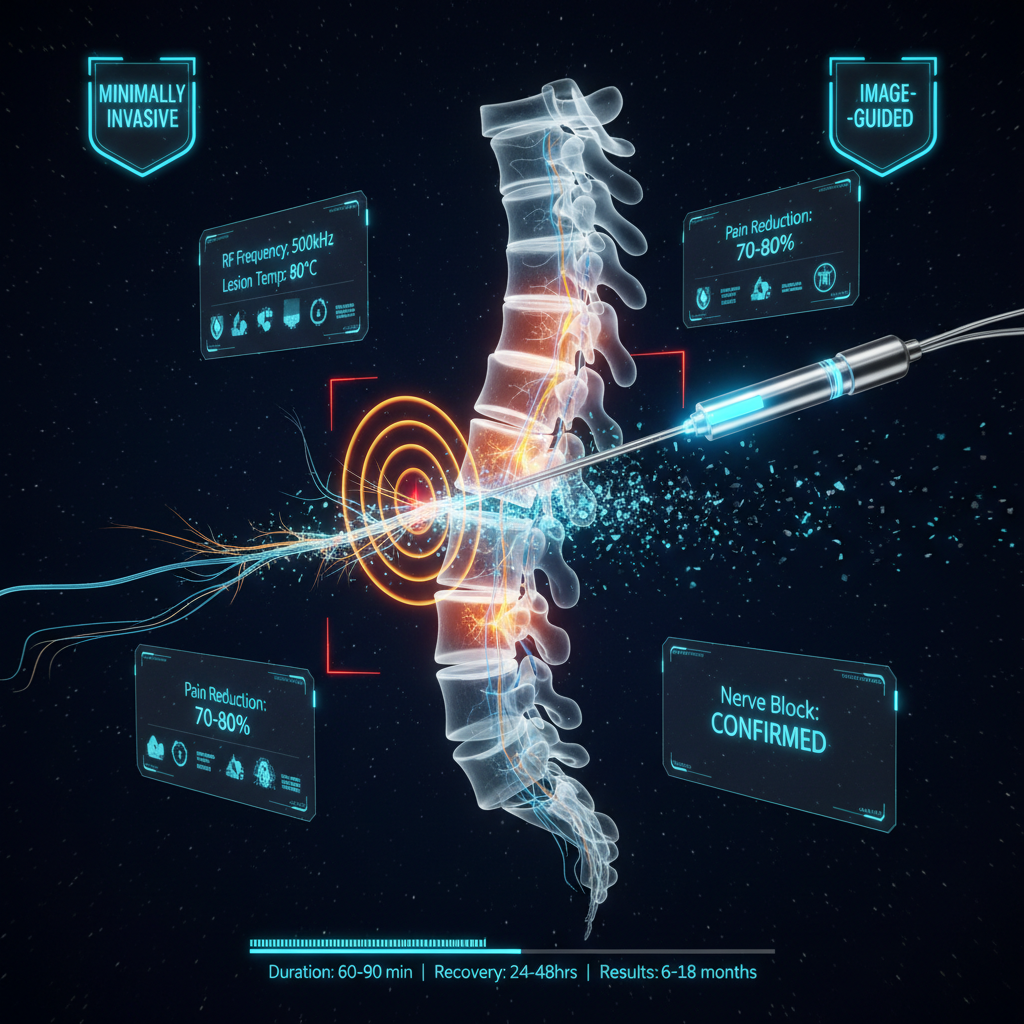
Radiofrequency ablation (RFA) is a minimally invasive interventional procedure in which a board-certified pain physician uses radiofrequency energy to generate a controlled thermal lesion on the medial branch nerve — the nerve responsible for transmitting facet joint pain signals to the brain. By heating the nerve to approximately 80°C, RFA disrupts the pain pathway at its source, providing 6–18 months of sustained relief for chronic cervical, thoracic, and lumbar spinal pain. Unlike steroid injections that reduce inflammation temporarily, RFA addresses the neurological mechanism of facet-mediated pain directly. Candidacy is confirmed through diagnostic medial branch blocks prior to the procedure.
How Radiofrequency Ablation Works
A precision image-guided protocol that uses controlled thermal energy to interrupt the nerve signals driving chronic facet joint pain — delivering lasting relief without surgery or systemic medications.
Radiofrequency Energy Ablation
A specialized electrode needle delivers precisely controlled radiofrequency energy — generating heat at 80°C — to interrupt the medial branch nerve responsible for transmitting facet joint pain signals to the brain, providing sustained relief.
Fluoroscopic Image Guidance
Real-time fluoroscopic (X-ray) imaging ensures the RFA electrode is positioned at the exact anatomical target — the medial branch nerve — for maximum therapeutic precision, safety, and reproducibility.
Medial Branch Nerve Targeting
RFA selectively targets the medial branch nerves that innervate the facet joints of the cervical, thoracic, or lumbar spine — interrupting the pain pathway without affecting surrounding motor function or structural integrity.
Outpatient Convenience
Each RFA session takes approximately 60–90 minutes under local anesthesia and mild sedation. Patients return home the same day with no hospital admission, no surgical incision, and minimal disruption to daily life.
Diagnostic Block Prerequisite
Candidacy for RFA is confirmed through medial branch blocks — diagnostic injections that temporarily numb the target nerve. Patients who achieve ≥50–80% relief from diagnostic blocks are ideal RFA candidates with predictable outcomes.
Integrated Rehabilitation
RFA is coordinated with physical therapy and functional medicine to maximize the pain-free window — using the relief period to rebuild core strength, restore biomechanical function, and reduce long-term recurrence risk.
Opioid-Sparing Protocol
By delivering durable nerve-level pain interruption, RFA significantly reduces or eliminates the need for opioid and non-opioid analgesics — supporting safer, long-term pain management without medication dependency.
Repeatable Treatment
As medial branch nerves naturally regenerate over 6–18 months, RFA can be safely repeated to restore pain relief — making it a sustainable, long-term management strategy for chronic facet-mediated spinal pain.
Why Choose RFA for Chronic Spinal Pain?
Unlike treatments that temporarily reduce inflammation or mask pain, radiofrequency ablation targets the neurological source of facet joint pain — disabling the specific nerve responsible for transmitting pain signals. The result is durable, sustained relief that enables active rehabilitation and long-term functional recovery.
Multiple randomized controlled trials and systematic reviews support RFA as the most effective long-term treatment for confirmed facet-mediated spinal pain — with outcomes superior to sham procedures, steroid injections, and conservative care for appropriately selected patients. (ASIPP Guidelines; Cochrane Review; Spine Journal)
RFA is a cornerstone of opioid-sparing pain management. By providing 6–18 months of nerve-level pain interruption, it significantly reduces or eliminates the need for opioid analgesics — supporting safer, long-term management of chronic spinal pain without the risks of medication dependency or systemic side effects.
The RFA Procedure Process
From diagnostic confirmation to full pain relief — a step-by-step overview of what to expect during your radiofrequency ablation treatment.
Before RFA, your physician performs medial branch blocks — targeted diagnostic injections that temporarily numb the suspect nerve. Patients achieving ≥50–80% pain relief confirm facet-mediated pain and are cleared as ideal RFA candidates.
Under real-time fluoroscopic guidance and local anesthesia, a specialized RFA needle electrode is precisely positioned at the medial branch nerve adjacent to the target facet joint — confirmed with sensory and motor stimulation testing.
Controlled radiofrequency energy heats the electrode tip to approximately 80°C for 60–90 seconds, creating a precise thermal lesion that interrupts the nerve's ability to transmit pain signals — without damaging surrounding motor nerves or spinal structures.
Most patients experience mild soreness for 24–72 hours before progressive pain relief develops over 1–3 weeks. The pain-free window — typically 6–18 months — is used to engage in physical therapy and functional rehabilitation to maximize long-term outcomes.
Spinal Conditions Addressed by Radiofrequency Ablation
RFA is most effective for chronic spinal pain confirmed to originate from the facet joints — conditions that have not responded adequately to conservative care, physical therapy, or corticosteroid injections, and where diagnostic medial branch blocks have confirmed the pain source.
Discuss Your ConditionRadiofrequency Ablation Questions Answered
Comprehensive answers to the most common questions about RFA — how it works, who qualifies, what to expect, how long results last, and how it compares to other spinal pain treatments.
Interrupt the Pain. Reclaim Your Life.
Radiofrequency ablation at NYC Pain Management delivers precision nerve-level pain interruption for chronic spinal conditions — providing 6–18 months of sustained relief without surgery, steroids, or opioids. If diagnostic blocks have confirmed your pain source, RFA may be the long-term solution you've been seeking.